By Samir Geepee · 5 min read
The Skill That Got You Here Is Quietly Holding You Back
Your biggest strength, if you do not evolve it, becomes your ceiling.
I worked with a senior manager who had spent ten years being the person with the answers.
Every problem that came up he solved it. Fast. Alone. Before anyone else in the room had finished thinking about it. He was brilliant at it. His career had been built on it.
And then he got stuck. Same level for three years. Watching people he considered genuinely less capable than him move ahead.
He came to me frustrated. He said I work harder than anyone. I deliver more than anyone. What is happening.
When I sat with him and watched how he operated in a session, I noticed something. Every time a challenge came up he solved it immediately, alone, in his head. Before anyone else had a chance to engage with it.
And I said to him, you are still playing the game you were rewarded for five years ago. The solo game. Figure it out, deliver, get the gold star. But the role you want now, that game does not work there.
When Strength Becomes a Ceiling
This is one of the most common and most painful patterns I see in high performing managers across the GCC. The very capability that accelerated their career becomes the thing that quietly caps it.
Being the smartest, fastest, most decisive person in the room is enormously valuable at a certain level of an organisation. It gets things done. It builds a reputation. It earns trust and responsibility.
But at a certain point the role changes. And the skills required change with it. And nobody tells you that the transition has happened.
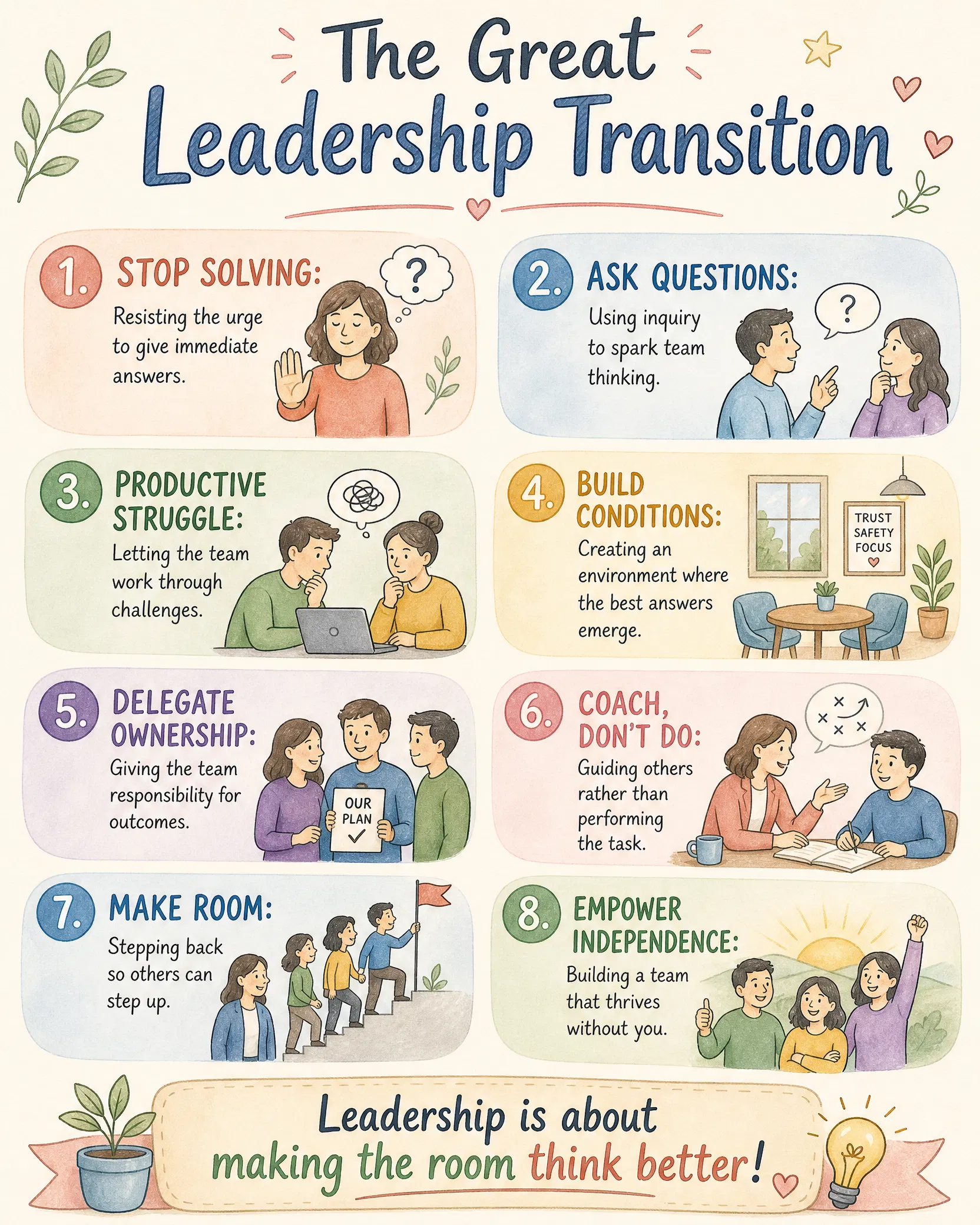
The new role does not need you to have the best answer. It needs you to build the conditions in which the best answer consistently emerges from the people around you. That is a fundamentally different job. And it requires the deliberate suppression of some of the instincts that made you successful.
"Your biggest strength, if you do not evolve it, becomes your ceiling. Not just for you. For everyone around you."
What the Transition Actually Requires
The managers I have watched make this transition successfully describe a similar experience. It feels like loss before it feels like growth.
There is a period where restraining the instinct to solve feels like underperforming. Where asking questions instead of giving answers feels passive. Where letting your team struggle productively feels irresponsible.
But on the other side of that discomfort is something worth getting to. A team that thinks independently. A leader whose energy is spent on the work only they can do. An organisation that does not collapse when the manager is not in the room.
The shift from being the best thinker in the room to making the room think better is the hardest transition in any management career. And in my experience the reason most managers do not make it is not that they cannot. It is that nobody ever named it clearly enough that they knew it was required.
Naming It Is the First Step
The manager I mentioned at the beginning of this article made the shift. Not overnight. Not without difficulty. But he made it.
The first thing that changed was not his behaviour. It was his understanding of what the job actually was. Once he saw clearly that the role he wanted required a different game entirely, the path became visible even if it was not easy.
If something in this article is landing for you, the question worth asking is simple. Are you still playing the game that got you here? Or have you started learning the one that will take you further.
Join the conversation
Be the first to share your thoughts on this article.