By Samir Geepee · 5 min read
There Is a Difference Between Doing Great Work and Being Known for It
Great work that stays within a team is invisible to the organisation.
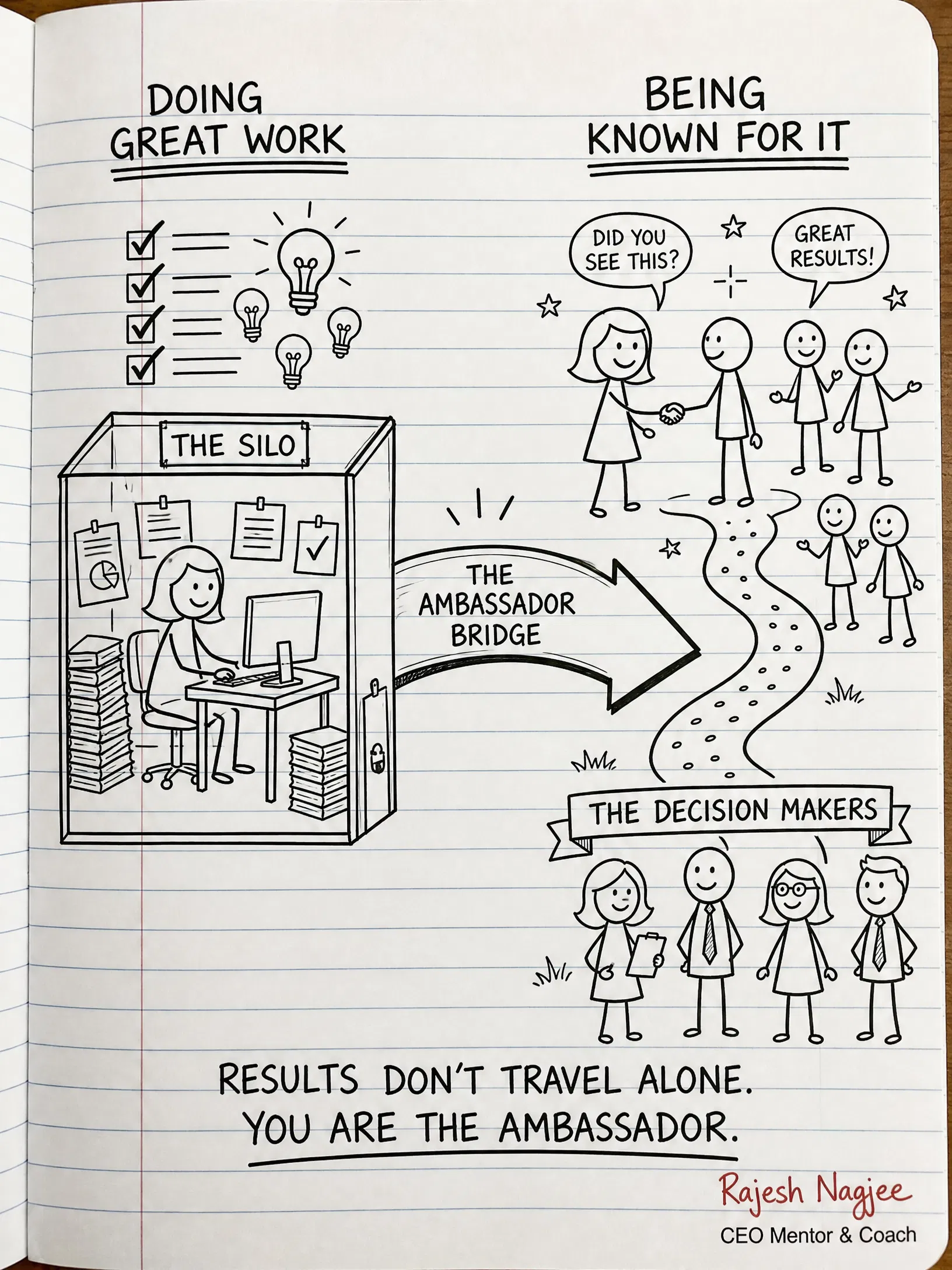
I want to tell you about a manager I worked with who was genuinely one of the best I had seen at his level.
Sharp. Reliable. The kind of person who made everything around him better without needing to be noticed for it. His results were consistently above what was expected. His team trusted him deeply.
And he watched someone else, someone he had clearly outperformed by any measurable standard, walk into the role he had been working toward for three years.
He came to me not angry. Genuinely confused. What did I do wrong, he asked.
Nothing, I told him. But let me ask you something. When was the last time the people who make these decisions really saw you. Not your work. You.
He thought about it for a long time. And could not answer.
The Ambassador Problem
Most high performers operate on an assumption that turns out to be expensive. They assume their work speaks for itself. That consistent delivery at a high level is its own form of visibility. That the results will find their way to the people who matter.
But work does not travel on its own. Results sit inside systems and reports and team meetings. They accumulate quietly. And the people who make decisions about careers are not always looking at the data. They are drawing on relationships, impressions, and conversations.
Great work that stays within a team is invisible to the organisation. And invisible work, however excellent, does not build a career at the pace the person doing it deserves.
His work was excellent. But it was staying with him. It was not traveling. It was not being talked about in rooms he had not yet entered.
"Results do not travel alone. You are the ambassador."
What the Other Person Had
The person who got the role was not more talented. I want to be clear about that because it matters.
But people knew him. They felt him. They had a sense of his thinking, his judgment, his character, from conversations and interactions that went beyond his formal output. When his name came up in the room where the decision was made, there was familiarity and confidence attached to it.
That familiarity did not come from performance reviews. It came from the relationships he had built deliberately over time with the people whose perception of him mattered.
That is not politics. It is not playing games. It is just the reality of how organisations work and how careers are shaped. And pretending otherwise is one of the most expensive beliefs a talented manager can hold.
Closing the Gap
The manager I worked with made a significant shift in the twelve months that followed. Not in how he worked but in how he made his work visible to the people who needed to see it.
He started contributing to conversations beyond his immediate remit. He built relationships with peers across the organisation who he had previously had no reason to engage with. He made his thinking visible in contexts where it could be seen by people who had previously only seen his results.
None of it felt natural at first. Most of it felt uncomfortably close to self-promotion.
But what he came to understand is that making your value visible is not the same as overstating it. It is simply taking responsibility for ensuring the right people have enough information to make a fair assessment of what you bring.
He got the next opportunity. And this time he was not confused about why.
Next Article
Silence in the Room Is Not Agreement
5 min read
Join the conversation
Be the first to share your thoughts on this article.