By Samir Geepee · 7 min read
The Moment You Became the Bottleneck — And Didn't Notice
There is a shift in management so gradual that most leaders miss it entirely.
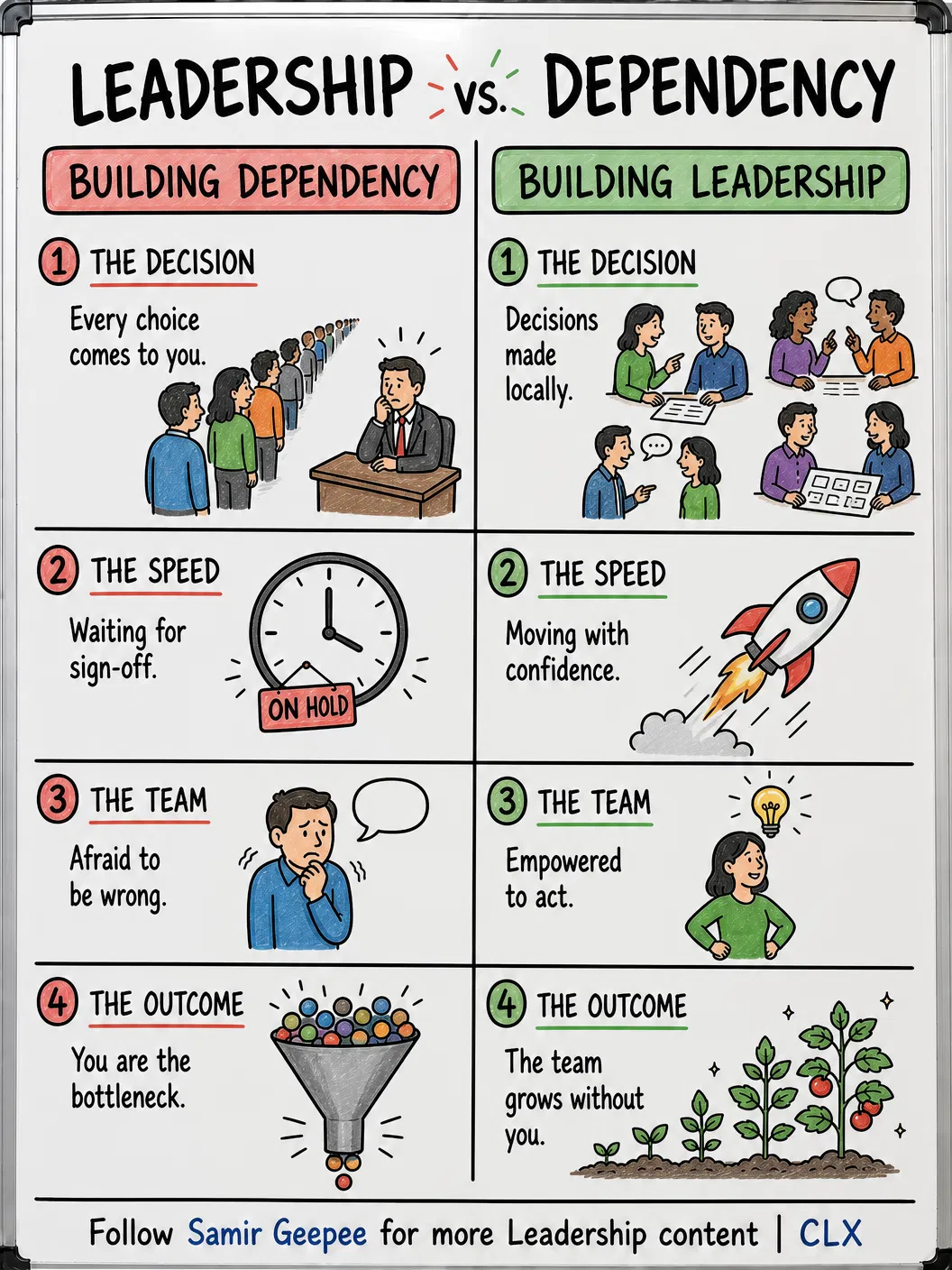
There is a shift that happens in management so gradually that most leaders completely miss it.
One day you realise your team has stopped deciding. They are waiting. Every question comes to you. Every move needs your approval. Every problem lands on your desk before it has been properly thought through by anyone else.
And the strangest thing is - it feels like trust. It feels like you are needed, respected, central to how things work. It feels like leadership.
It is not. It is dependency. And in almost every case I have seen, the leader built it themselves.
How It Happens
Nobody becomes a bottleneck on purpose. It happens through a series of completely understandable decisions.
A problem comes up and you solve it quickly because you can. Your team sees that and learns: bring problems to the manager, they get resolved faster. So they bring more problems. You solve more problems. The cycle accelerates.
Over time, your team stops developing the muscle of working through difficult decisions themselves. Why would they? Every time they start to struggle, the answer arrives from above. The struggle - which is exactly where real thinking and growth happens - gets removed from the equation.
What you have built, without meaning to, is a team that has outsourced its thinking to you. They are not lazy. They are not incapable. They have simply been trained, through your behaviour, to need you.
"Every time you stepped in too fast, solved it before they could, or made it easier to ask you than to back themselves - you trained your team to need you."
The Two Different Jobs
The core issue is that many managers are still doing the job they were promoted for - being the best thinker in the room - when the job they actually hold now requires something completely different.
Early in a management career, individual brilliance is rewarded. You figure it out faster than anyone, you deliver, you get recognised. That is the game, and you win it.
But at a certain level of leadership, that same instinct starts to work against you. Because the role you hold now does not need you to have the best answer. It needs you to create the conditions in which your team consistently produces the best answers - with or without you in the room.
That is a fundamentally different skill. It requires restraint rather than speed. Curiosity rather than certainty. Questions rather than answers. And most managers were never taught it, because they were busy being rewarded for doing the opposite.
What the Shift Requires
Making this transition is not comfortable. It means watching your team struggle with problems you could solve in ten minutes - and staying quiet. It means asking questions in meetings instead of giving answers. It means measuring your success by what your team produces, not what you personally contribute.
For high performers with strong instincts, this is genuinely difficult. The urge to step in, to fix, to be useful in the most visible way - it does not disappear overnight.
But the leaders I have watched make this shift describe the same outcome on the other side: a team that moves faster, thinks better, and requires less from them on every individual decision. A team that has grown into something that does not collapse when the manager is not there.
The Question Worth Sitting With
Look at your last week of meetings. How many times did you give an answer when you could have asked a question? How many decisions landed with you that your team was capable of making themselves?
And more importantly - what are you doing with the time and energy you are spending being the bottleneck?
Leadership is not about making the best decisions. It is about building the people who do not need you to.
Join the conversation
Be the first to share your thoughts on this article.