By Samir Geepee · 6 min read
Why I'm Capping CLX at 24 Members — And Why I'll Keep Saying No
The cap is not a constraint. It is the whole point.
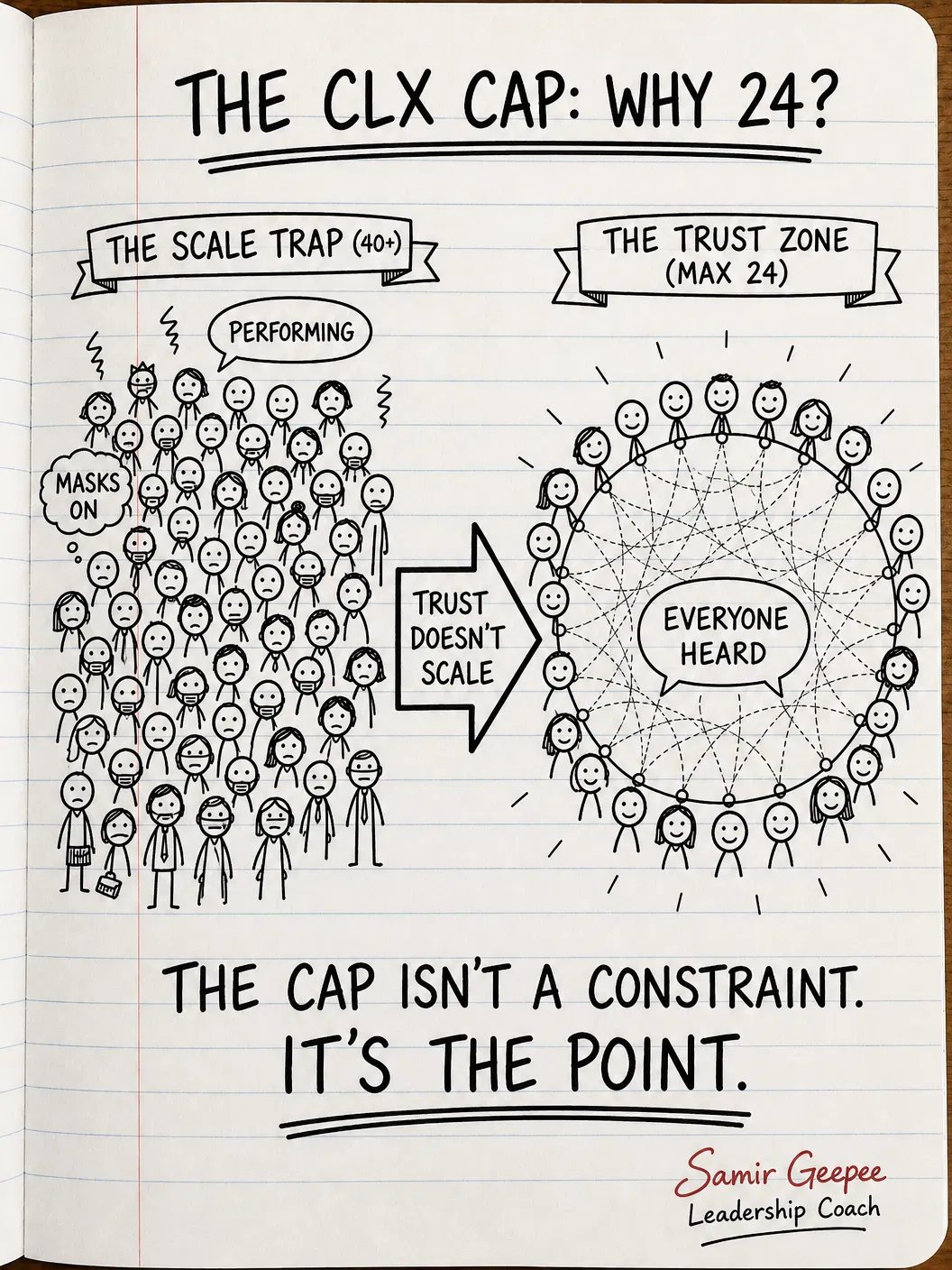
When I tell people that CLX is capped at 24 members - that there is a waitlist, that I turn people away regardless of title or background - the reaction is almost always the same.
Why would you limit it? You could help more people. You could build something bigger.
I understand that reaction. Growth is the default logic in almost every professional context. More members means more impact, more revenue, more reach. It makes sense on paper.
But CLX is not built on that logic. It is built on something that does not scale. And that thing is trust.
Trust Has a Number
I have spent enough time in rooms of different sizes to know that the dynamics shift significantly as numbers grow. In a room of 8 to 24 people, something specific is possible that disappears at 30, and is completely gone by 40.
In a smaller room, everyone is accountable to the conversation. There is nowhere to hide. You cannot be a passive observer - the room is too small and the expectation too clear. You are either present or you are not, and it shows immediately.
In a larger room, the opposite happens. People begin to perform. They answer questions with the version of themselves they want others to see, rather than the version that is actually navigating something difficult. Hands go up with polished insights. Real questions stay unasked. The mask, which should come off in a room like this, stays firmly in place.
"The moment I let CLX become just another program, it stops being what it is. The cap is not a constraint. It is the whole point."
What Happens at 24
At 24 people, something different is possible. Not guaranteed - but possible.
Everyone gets genuinely heard. Not in a performative way, but in the way where you can feel that the people in the room are actually thinking about what you said and responding to it honestly.
Everyone gets challenged. Not aggressively - but in the way a peer challenges you when they are not competing with you and have no agenda beyond the quality of the thinking in the room.
Relationships form that are real. Not the kind you collect on LinkedIn, but the kind where you can message someone three months later and say - I am dealing with something, can we talk? And they say yes because they actually know you.
That does not happen at 40. It does not happen at 60. It happens at 24. Which is why 24 is the number.
The Waitlist Is Not a Marketing Tactic
I want to be direct about this because I know how it can look from the outside.
The waitlist is not designed to create artificial scarcity or manufacture demand. It exists because the room fills up, and I will not compromise the quality of what happens inside it by adding more seats.
When I say no to someone, it is not a judgment on their capability or their value as a leader. It is simply a commitment to the people who are already in the room - that their experience will not be diluted because I decided to grow faster than the room can hold.
The Bigger Principle
There is a broader point here that applies beyond CLX.
Some of the most valuable things in leadership cannot be scaled. The honest conversation. The moment of real challenge. The relationship built over time in a room where nobody is performing.
We live in a world that optimises for scale, speed, and reach. And there is a place for all of that. But the things that actually change how a leader thinks and operates - those tend to happen in small rooms, slowly, between people who are genuinely present with each other.
CLX stays small because that is the only way it stays real.
Next Article
The Feedback Nobody Gives You Anymore
5 min read
Join the conversation
Be the first to share your thoughts on this article.