By Samir Geepee · 7 min read
What a 24-Person Room of Peers Can Do That a Conference Cannot
Most leaders have plenty of information. What they are short of is clarity.
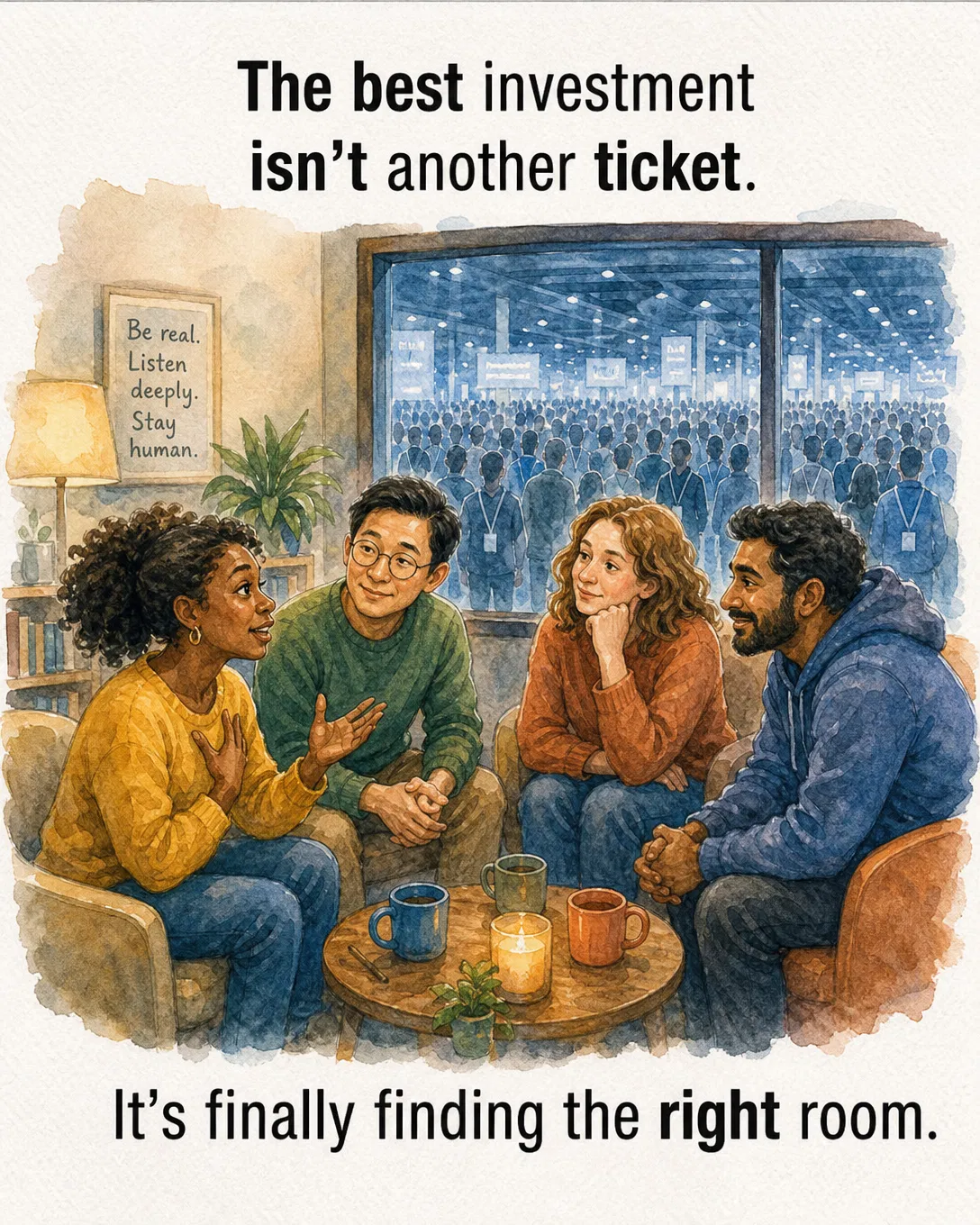
Senior leaders in this region attend a lot of conferences.
They sit in ballrooms with hundreds of people. They listen to keynotes from impressive speakers. They collect business cards, fill notebooks with frameworks, and take photographs of slides that contain insights that feel important in the moment.
And then they go back to work. And within two weeks, almost nothing has changed.
This is not a criticism of conferences. They serve a purpose. But there is a specific gap they cannot fill - and that gap is exactly where most senior managers are stuck.
The Problem With Scale
A conference is designed for information transfer at scale. The format optimises for one-to-many communication - a speaker with expertise, an audience receiving it. That model works well for certain things.
But leadership development is not primarily an information problem. Most senior managers already have access to more frameworks, models, and ideas than they could implement in a decade. The gap is almost never knowledge.
The gap is processing. Reflection. The honest conversation about what is actually happening in their leadership - not in theory, but right now, this week, in their actual organisation with their actual team.
A conference of five hundred people cannot provide that. The format simply does not allow for it.
"The gap is not knowledge. It is the honest conversation about what is actually happening in their leadership right now - not in theory, but in their actual organisation."
What Changes in a Smaller Room
When you put 24 people in a room - same level, different organisations, no hierarchy, no shared political context - the dynamics shift fundamentally.
First, anonymity disappears. In a room of 24, you cannot hide. You are either present or you are noticeably absent. That accountability changes how people show up. They arrive prepared to engage, not to observe.
Second, the conversation becomes real. Without the professional distance that comes from being in a large group, people say what they are actually thinking. Problems get named. Doubts get voiced. The version of events that gets shared is the honest one, not the polished one.
Third, the challenge becomes personal. In a large conference, feedback is generic - it has to be, because the speaker does not know you. In a room of 24 peers, the challenge is specific to your situation, your thinking, your blind spots. That specificity is what makes it useful.
The Moment That Does Not Happen at Conferences
There is a specific moment I have watched happen repeatedly inside CLX that I have never seen at a conference or a training event.
Someone says the thing they have been carrying alone for weeks or months. The problem they have not said out loud to anyone - not their team, not their boss, not their family. They say it in the room.
And then three other people go quiet. Because they have been carrying the same thing.
That moment of shared recognition - of realising that what felt like your unique failure or confusion is actually a common experience at this level - is worth more than most things a conference can offer. It does not solve the problem. But it dissolves the isolation around it. And that shift in isolation often unlocks the thinking that was stuck.
Information Versus Clarity
The distinction I keep coming back to is the difference between information and clarity.
A conference gives you information. New data, new frameworks, new perspectives from people who have thought deeply about a topic. That has value.
A peer room gives you clarity. It helps you understand your own situation more precisely. It surfaces the question you were not asking. It reflects back to you - through the responses and challenges of people who are actually listening - something about how you are thinking that you could not see from inside your own head.
Most senior leaders have plenty of information. What they are short of is clarity. And clarity, in my experience, almost always comes from conversation - not content.
What You Actually Leave With
The difference in what you take home from each experience tells the story.
From a conference: a notebook, a few LinkedIn connections, some ideas that felt exciting but have not been translated into action.
From the right room: a clearer sense of what you are actually dealing with, a handful of people who now know you in a real way, and at least one question that will stay with you and keep working.
That is not a small thing. At the level most CLX members operate at, one clear question - genuinely asked and genuinely sat with - can change the direction of a decision, a team, or a career.
Join the conversation
Be the first to share your thoughts on this article.