By Samir Geepee · 5 min read
You Do Not Wait for the Ships. You Build the Port.
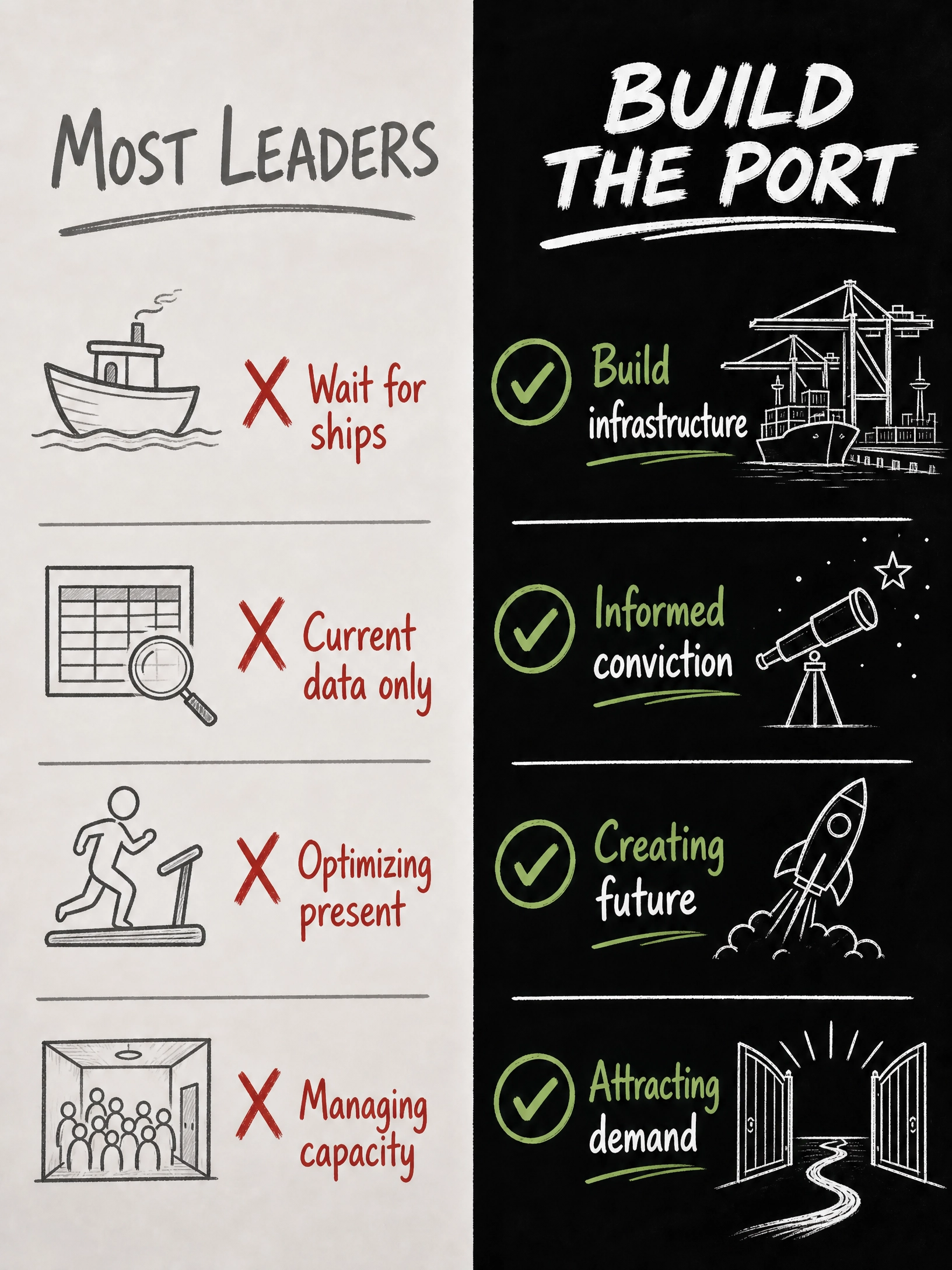
The demand follows the infrastructure. Most leaders wait for the ships. The ones who change industries do it the other way around.
When Sheikh Rashid bin Saeed started building Jebel Ali Port in 1976 the critics were immediate and vocal.
There were no ships to fill it. No trade to justify the scale. No data that supported the investment. The infrastructure was being built for a future that did not yet exist and showed no clear signs of arriving.
You are building capacity you have no demand for. You are spending money you cannot justify. You are ahead of reality.
And Sheikh Rashid's response, in its essence, was this. The demand follows the infrastructure. You do not wait for the ships. You build the port.
Today Jebel Ali is the ninth busiest port on Earth. It handles over fourteen million containers a year and is the economic backbone of everything Dubai has become. The critics from 1976 are a footnote that nobody remembers.
The Question Most Leaders Get Wrong
I share this story with leaders across the GCC not because it is an impressive piece of history but because of the question it surfaces.
Are you building for the organisation you currently have. Or the organisation you are trying to create.
Most leaders, if they are honest, are doing the former. They are managing current capacity to meet current demand. They are justifying every investment with existing data. They are building the next quarter on the foundations of the last one.
And there is nothing wrong with that. It is responsible. It is defensible. It is how most organisations are managed.
But it is not how anything truly significant gets built.
"The demand follows the infrastructure. Most leaders wait for the ships before they build the port. The ones who change industries do it the other way around."
Informed Conviction vs Recklessness
There is an important distinction to make here that the Jebel Ali story illustrates clearly.
Building ahead of demand is not the same as recklessness. Sheikh Rashid was not making a random bet. He understood the geography, the trajectory of global trade, the potential of the region, and the gap that existed between what was available and what the future would require.
He was operating from informed conviction. The belief that if the infrastructure was built well enough and positioned correctly, the world would reorganise itself around what had been created.
That is a different posture than pure optimism or wishful thinking. It requires deep understanding of the direction things are moving combined with the courage to commit to a future that is not yet visible in the data.
What This Means for Your Leadership
In practical terms the question this raises for any leader is about where they are placing their attention and their investment.
Building for the organisation you have means optimising what already exists. Improving processes, managing costs, developing the team you currently have for the roles they currently hold.
Building for the organisation you are trying to create means investing in infrastructure before the need is fully visible. Developing leaders for roles that do not yet exist. Creating capability that the current moment does not yet require but the future will demand.
The organisations I see doing this well are not the ones with the biggest budgets. They are the ones whose leadership has made a clear decision about what they are building toward. And they are making investments today that only make sense if you believe in that future.
The ships are coming. The question is whether you will have the port ready when they arrive.

Join the conversation
Be the first to share your thoughts on this article.